Abdelatif Laamrani
Books
LexisNexis · Forthcoming
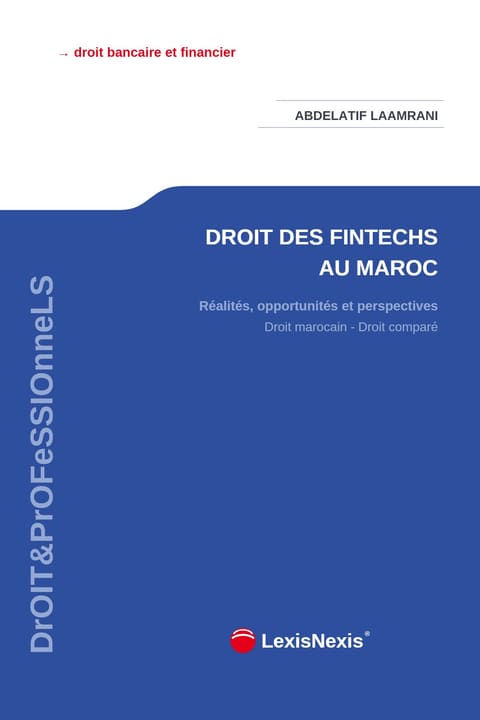
Droit des Fintechs au Maroc
Réalités, opportunités et perspectives
Droit marocain, droit comparé
Framing the legal environment is an essential issue in the development of financial technologies.
In Morocco, where the Fintech ecosystem is growing considerably, driven by mobile payments, open banking and the emergence of crypto-assets, the same need for legal certainty is being felt.
For the first time, this book sets out to meet that need through a systematic study of the law applicable to Fintechs in Morocco: the status of payment institutions, crypto-assets and draft law No. 42-25, open banking and banking data, artificial intelligence applied to finance, decentralised finance, central bank digital currencies, cybersecurity and personal data protection.
Each chapter offers a comparative approach with French and European Union law, enriched by the experiences of Brazil, South Korea, Singapore and the United Arab Emirates, in order to shed light on the realities, opportunities and prospects of the Moroccan framework.
The book is intended for everyone working in financial technology and digital finance (bankers, Fintech executives, financiers, regulators, chartered accountants, lawyers, bank in-house counsel and compliance officers). It will also be of use to teachers, researchers and students dealing with the digital transformation of banking and financial law.
LexisNexis, Droit & Professionnels collection, Banking and Financial Law series. A treatise in four parts and 25 chapters, with index and glossary.
LexisNexis · 2023
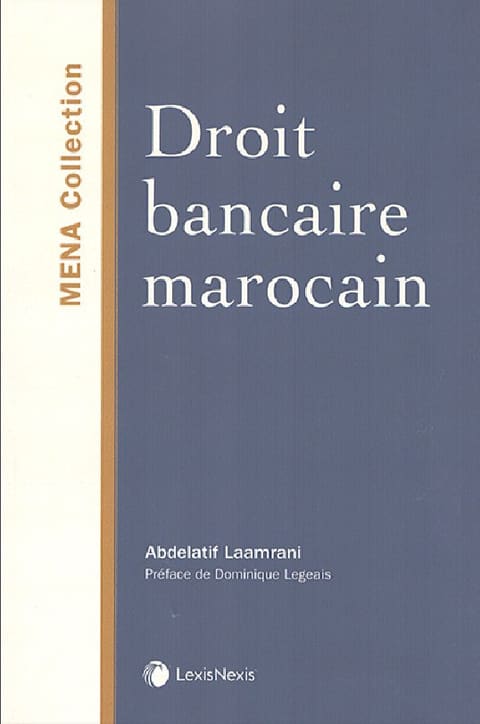
Droit bancaire marocain
The MENA Collection
Foreword by Professor Dominique Legeais
Professor Dominique Legeais is a professor of private law at Université Paris Cité, where he heads the Centre for Business Law and Management (CEDAG), and a member of the Paris bar. Co-editor of the Revue de droit bancaire et financier, where he writes the column on security interests, he is the author of, among other works, Droit des sûretés et garanties du crédit (LGDJ), Droit commercial et des affaires (Sirey), Opérations de crédit and Blockchain et crypto-actifs (LexisNexis).
Banking today shapes and influences the whole of modern life. In Morocco it is of recent origin, yet the legal mechanisms of banking activity carry considerable weight there; they have been enriched and modernised through dynamic legislation, rising to international standards without ignoring national specificities.
This book is also intended as a working tool, both theoretical and practical, for researchers, bankers, regulators, investors, academics, lawyers and judges interested in banking and financial law.
To make it fruitful and practical reading for all practitioners in banking and finance, it contains hundreds of recent references to legal scholarship and case law. It addresses many of the issues facing banking practice in Morocco today: adapting banking services to consumer-protection obligations, the emergence of new payment methods, the digitalisation of banking, the internationalisation of compliance, the challenges of banking regulation and supervision, and more.
LexisNexis, The MENA Collection, January 2023, 565 pages. ISBN 978-2-7110-3809-1.

L’Harmattan · 2016
Le rôle du gouverneur au Maroc
Foreword by Michel Verpeaux · Introduction by Michel Rousset
In Morocco, local administrative organisation is the result of a long evolution and of the combination of traditional and modern institutions. The governor is one of the central figures of this organisation. He was, and remains, the representative of the King in the prefectures, provinces and regions of the Kingdom, where he must act not only as guarantor of public order but also as coordinator of the field services of the various ministries.
The author sheds light on the origins and the place of the governor’s institution within the local administrative order. His approach is at once legal, historical, sociological and anthropological.
L’Harmattan, 1 December 2016, 696 pages. ISBN 978-2-343-10150-7. Also available as an e-book (ePub, PDF).